
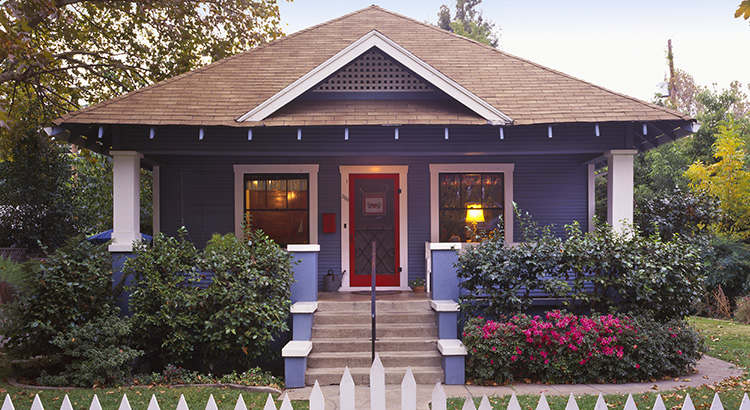
The advice has become standard: prices are high, so buy less house. It is reasonable advice, and buying a smaller home genuinely does solve some problems. But the national version of this story does not describe what is available in Monmouth and Ocean County, and the savings are not proportional to the square footage you give up.
Here is what the data actually shows, and what it means for a search around here.
The national story is real
Builders have been shrinking houses for about a decade. The median new single-family home finished Q4 2025 at 2,183 square feet, and home size has been trending down since 2015 as affordability tightened.
That is a deliberate response to payment math. A builder who cannot sell a 2,800-square-foot house at today’s rates builds a 2,100-square-foot house instead.
So the trend is genuine. It is just not evenly distributed.
Why buying a smaller home is harder here
This is the part that gets left out, and it explains a lot of local frustration.
Between 2012 and 2022, the average new single-family home shrank 1% nationally. The South lost 3.3%. The Midwest lost 2.0%.
The Northeast grew 8.0%, to an average of 2,756 square feet — the largest new homes in the country. We are the one region that went the other way.
The reason is land. When a lot in Spring Lake or Sea Girt is most of what you are paying for, building a modest house on it does not pencil. Teardown economics push toward the largest structure the zoning will allow, because the land cost is fixed regardless of what you put on it.
Which means the national trend of smaller, cheaper new construction largely has not reached eastern Monmouth. The new houses going up near the water are bigger than the ones they replaced.
Where smaller new homes actually are locally
They exist. They are just not where most buyers start looking.
Inland Monmouth and Middlesex. Townhome communities and smaller single-family product, newer construction, more predictable pricing.
Ocean County. The deepest supply of smaller new and newer homes in the area, and meaningfully lower property taxes than most of Monmouth.
Adult communities. Abundant in Ocean County, scarce in eastern Monmouth, and a completely different market in terms of pace and resale.
What you will not find: much new small product in the Shore boroughs. If that is where you want to be, the smaller house you buy will be an older one, and that is a different project entirely.
The catch: buying a smaller home costs more per square foot
This is the number that catches people, and it is worth understanding before you set a budget.
Half the house is not half the price. The expensive rooms do not shrink proportionally. A kitchen is a kitchen, bathrooms are bathrooms, and the mechanical systems, the roof, the foundation and the permits are substantially the same job on a 1,800-square-foot house as on a 2,800-square-foot one.
So the cost spreads across fewer feet. Nationally, average price per square foot on new construction reached $168 in 2022, up 95% in a decade. The Northeast was already at $212.
The practical version: a buyer who drops their target from 2,600 to 1,900 square feet expecting a 27% price cut usually finds something closer to 15%. Real, but not what they budgeted for.
What buying a smaller home actually saves
The savings are real. They are just mostly not in the purchase price.
Property taxes. The big one in this state, because assessment follows improvement value. On a Monmouth tax bill that averages five figures in most towns, a smaller house is a permanently smaller bill, and it compounds every year.
Utilities. Less space to heat and cool, and near the water that matters more than people expect given how hard the salt air is on HVAC equipment.
Maintenance. Fewer square feet of roof, siding, windows and flooring to replace on a schedule.
Insurance. Replacement cost scales with size, and in a coastal market the premium is already a larger line item than it is elsewhere.
Add those up over a ten-year hold and they frequently exceed the difference in purchase price. Which is the honest case for buying a smaller home here: the monthly carry, not the sticker.
The trade that works best around here
Here is the version I would actually recommend, and it runs against most buyers’ instincts.
Trade square footage for town, not square footage for price.
The town you land in drives your tax bill, your commute, your schools and your eventual resale far more than the extra bedroom does. A smaller house in a town you want beats a larger house in a town you settled for, and the price difference between those two is usually smaller than the difference in what you will pay to own them. I went through how much the town drives the tax number in the piece on downsizing and property taxes.
The corollary matters too: do not let a national narrative set your expectations for a local search. The gap between national and regional figures here is wide enough that it misleads in both directions, which I covered in what home price headlines miss about this county.
The bottom line
Buying a smaller home is a sound strategy in this market, with two adjustments to the national script.
First, the smaller new construction the national data describes is mostly inland and in Ocean County, not near the water. Second, the savings show up in taxes, utilities, maintenance and insurance rather than in a proportional discount on the purchase price.
Budget on the monthly carry rather than the price per square foot, and the strategy holds up well. Budget on the assumption that 30% less house means 30% less money, and it will not.
If you want to compare the real monthly cost of a smaller house in two or three different towns, get in touch and I will run them side by side. And if the down payment is the part holding you up, it probably needs to be smaller than you think.
Ready to look? You can search every listing in the area here, straight from the MLS and updated continuously.
New home size figures reflect Census data as analyzed by the National Association of Home Builders through Q4 2025. Size and price-per-square-foot comparisons by region reflect a 2012 to 2022 analysis of new single-family construction and are national and regional averages rather than local figures. Property tax, utility, insurance and maintenance savings vary by property. I am a real estate agent rather than a builder, lender, or insurance professional.

Shea Merritt is a licensed New Jersey real estate agent with eXp Realty, working with buyers and sellers across Middlesex, Monmouth, and Ocean counties. He grew up in Old Bridge. He writes here about the arithmetic behind a move: what a house would actually bring today, what the tax line does to a monthly payment, and how to compare offers on their terms rather than on the top number. If you are weighing a sale or a purchase, send him the address and he will run the numbers on it.