
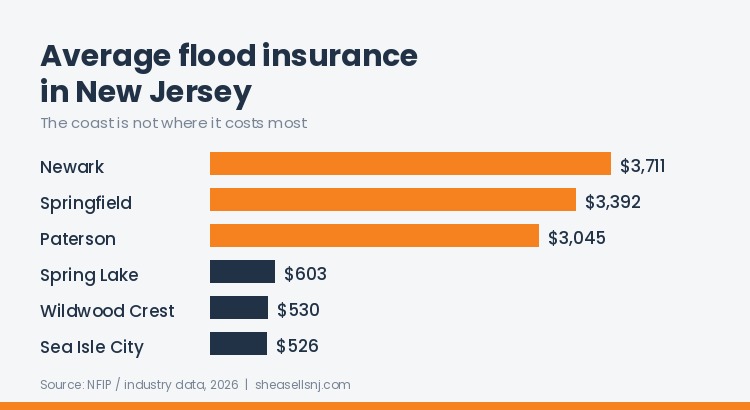
Ask someone where flood insurance costs the most in New Jersey and they’ll picture a house on the water in Ocean County. The expensive end is inland, along the rivers.
An analysis of National Flood Insurance Program data covering New Jersey towns with at least 500 policyholders put the highest average premiums in Paterson, at $2,353 a year, followed by Wayne at $2,316, Fairfield at $2,241 and Pequannock at $2,136. The cheapest were Shore addresses. Sea Isle City came in at $526, Wildwood Crest at $530, Monmouth Beach at $600 and Spring Lake at $603.
Those figures run on NFIP data accessed in 2022, so read them as the shape of the pattern rather than this year’s prices. The inversion tells you almost everything about how flood insurance works now — and why the assumptions buyers bring to Shore properties are usually a decade out of date.
Why Shore flood insurance got cheaper and the rivers got expensive
Two things happened.
After Sandy, an enormous amount of coastal housing was rebuilt or raised onto pilings, and building standards tightened. A home elevated well above the base flood elevation is genuinely lower risk, and it now prices that way.
Inland river communities didn’t go through that. Older, non-elevated housing stock along the Passaic and Raritan never got the same wholesale rebuild, so those properties carry the risk they always had — and increasingly the premiums to match.
The rule change that matters: elevation beats zone
FEMA’s Risk Rating 2.0 changed how premiums are calculated. Under the old system, your flood zone label drove the price. Under the new one, your elevation relative to the base flood elevation is the dominant factor, along with distance to water, rebuild cost, and flood frequency.
The practical consequence: two neighbors on the same block, in the same zone, can pay very different premiums. Reading a zone letter off a listing tells you far less than it used to.
The single highest-value document you can get
An elevation certificate is a form prepared by a licensed surveyor establishing exactly how high your structure sits relative to the base flood elevation.
Without one, FEMA prices your property using modeled estimates — which may be less accurate and less favorable than reality. With one, you’re priced on measured fact.
Costs run somewhere between $200 and $1,500 depending on the property and who you ask. Industry sources report that discovering your home sits even a foot higher than modeled can reduce premiums by $500 to $2,000 a year. If that holds for a given property, the certificate pays for itself in the first year and every year after.
If you’re buying: ask whether the seller already has one. Many post-Sandy rebuilds do, and it transfers with the property.
The $250,000 ceiling nobody mentions
This one matters disproportionately in Monmouth County. The National Flood Insurance Program caps building coverage at $250,000.
If you’re buying a $900,000 home near the water, an NFIP policy covers a fraction of the structure. Closing that gap means a private flood policy on top, or instead — carriers like Neptune, Wright Flood, and Aon Edge write policies that can cover full replacement cost.
Get quotes from both the NFIP and at least one private carrier. Which is cheaper depends entirely on the individual property, and there’s no way to know without asking.
Four things to check before you make an offer
Look the address up yourself at FEMA’s Flood Map Service Center. A screenshot in a listing is orientation, not diligence.
Ask for the seller’s current premium and declarations page. The actual number they pay beats any estimate.
Ask whether the town participates in the Community Rating System. Over 100 New Jersey communities do, and it earns residents a discount on premiums in high-risk areas.
Budget for increases. Risk Rating 2.0 caps annual premium growth at 18% for primary residences, and many New Jersey properties are still transitioning upward toward full-risk pricing. Today’s premium is not necessarily next decade’s.
Two things sellers should know
New Jersey law requires you to disclose known flood damage history. Beyond the legal obligation, buyers will find the flood zone regardless — providing the elevation certificate and your current premium upfront tends to produce smoother closings than letting underwriting surface it in week three. Those rules were rewritten in 2024, and the flood disclosure now runs to eight specific questions.
And if your home was elevated after Sandy, that’s a selling point worth stating plainly. A low premium on a coastal property is unusual enough that buyers assume the opposite unless you show them.
The bottom line on flood insurance here
Standard homeowners insurance never covers flood damage — not here, not anywhere. That catches first-time buyers from inland states constantly.
But the reflexive assumption that a Shore address means punishing flood insurance is no longer reliable, and the reverse assumption about inland property is equally wrong. The only number that means anything is a real quote on a specific address.
Get that quote before you’re under contract, not after. It belongs in your monthly budget alongside property taxes, and for coastal properties it can be the difference between comfortable and stretched.
Town-level premium figures come from an analysis of National Flood Insurance Program data accessed in 2022 and linked above. Averages vary considerably by property and ranges differ between sources, so treat them as a pattern rather than a quote. I’m a real estate agent, not an insurance professional — get quotes from a licensed agent and verify flood designations at FEMA’s Flood Map Service Center before making decisions.

Shea Merritt is a licensed New Jersey real estate agent with eXp Realty, working with buyers and sellers across Middlesex, Monmouth, and Ocean counties. He grew up in Old Bridge. He writes here about the arithmetic behind a move: what a house would actually bring today, what the tax line does to a monthly payment, and how to compare offers on their terms rather than on the top number. If you are weighing a sale or a purchase, send him the address and he will run the numbers on it.